9 Best Robotic Pool Cleaners for Algae (November 2026)
The best robotic pool cleaners for algae include the Dolphin Nautilus CC (best overall for algae), the AIPER Scuba X1 for fine algae particles, and the Dolphin Nautilus AG for flat-floor above-ground pools.
On this page (9 sections)
- The best robotic pool cleaners for algae, ranked
- How these robotic pool cleaners compare
- How we compared these pool cleaners for algae
- Do robotic pool cleaners pick up algae?
- What filter rating do you need for an algae bloom?
- How to vacuum a pool with a robotic cleaner after algae
- Corded or cordless for algae cleanup?
- Which cleaning features matter most when algae is the problem?
- Best robotic pool cleaner for algae: the verdict
The best robotic pool cleaner for algae is the Dolphin Nautilus CC, a corded wall climber with an active scrubbing brush and a top-load basket you empty without reaching into the water. Choose the AIPER Scuba X1 for fine green particles, or the Dolphin Nautilus AG for a flat above-ground floor.
A robot vacuums up algae and the debris it clings to, but it does not replace water chemistry. The right cleaner keeps dead algae from settling back into the water while you fix the bloom.
Our score weighs specs, features and buyer feedback against what you're shopping for. We ranked corded and cordless models by how well they scrub walls, filter fine particles and fit different pool shapes.
Our picks at a glance
-
1

-
2

-
3

- 4
 Check it
Nepturox Cordless Robotic Pool Cleaner
Best for large pools with full coverage - 5
 Best for scheduled daily cleaningCheck it
- 6
 Best budget above-ground pickCheck it
- 7
 Best for quick refresh cyclesCheck it
- 8
 Check it
2026 Release Robotic Pool Vacuum (Wall Climbing)
Best for sloped pool floors - 9
 Best for app-controlled wall scrubbingCheck it
The best robotic pool cleaners for algae, ranked
The Dolphin Nautilus CC leads because it combines wall scrubbing with a filter you can rinse in minutes. Every other pick here earns its place by solving one specific algae problem better than the rest.
Dolphin Nautilus CC: Best overall for algae
- Wall climbing scrubber brush
- Top-load filter basket
- Corded electric
- Ideal for pools up to 33 ft
A corded wall climber with an active scrubbing brush and a basket you empty from the top. It suits pool owners who want steady cleaning without charging a battery.
Pros
- Climbs walls to scrub algae films
- Top-load basket is easy to empty
- Runs from a cord with no recharge wait
Cons
- Cord needs managing in the water
- Corded models cost more to run than battery units
The Nautilus CC suits a pool owner who wants a set-and-forget cleaner for a pool up to 33 ft long. Its active scrubbing brush works the walls and floor, so algae films that cling to surfaces get lifted rather than left in place.
Dolphin says the brush is gentle on surfaces but tough on debris.
A top-load filter basket makes the biggest daily difference during a bloom. You lift the lid, rinse the basket and drop it back without turning the robot over.
Dolphin says the unit runs a cleaning cycle in about 2 hours. The body measures 22.2 by 17.6 by 12.8 inches and weighs about 14.8 lb, so it is manageable to pull out at the end of a run.
Because it runs from a cord, there is no battery to charge between passes. The trade-off is cord management and the higher running cost of a powered unit.
Dolphin backs it with a 1-year warranty and lists regular top-load filter cleaning as the main care step.
Buy it for whole-pool algae cleanup on a rectangular or freeform pool. Skip it if you need a cleaner with no cord in the water.
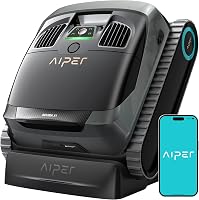
AIPER Scuba X1: Best for fine algae particles
- 6600 GPH dual-jet suction
- 3μm MicroMesh filter
- Reaches 2 in above the waterline
- Wireless charging dock
Dual jets and a 3μm filter pull in the fine green haze that settles after a bloom. The dock keeps it charged and stored between runs.
Pros
- Very fine 3μm filtration
- Dual-jet suction for stuck debris
- Cleans up to 2 in above the waterline
Cons
- Battery runtime is finite per cycle
- Needs a dock spot near the pool
The AIPER Scuba X1 suits a pool that turns cloudy rather than thick green. Its dual-jet suction and 3μm multi-layer filter capture the fine particles that a coarse basket lets through.
AIPER calls the MicroMesh filter its pick for day-to-day cleaning of unseen particles.
AIPER rates suction at 6600 GPH and says the robot reaches 2 inches above the waterline, with 60 seconds of sustained horizontal cleaning up there. Dual front PVC brushes tackle and polish wall stains, which is where algae often takes hold first.
The multi-layer system is the reason this cleaner sits at the top of the fine-filtration group.
Runtime runs up to 180 minutes from a 16-cell lithium-ion battery, and the wireless charging dock gives it a home between cycles. A 2-year warranty is longer than the Dolphin's.
The trade-off against the Nautilus CC is that it depends on battery charge and a dock spot near the pool.
Buy it for fine algae haze and waterline stains. Skip it if you prefer a corded unit that never needs recharging.
Dolphin Nautilus AG: Best for flat-floor above-ground pools
- Active scrubbing brush
- Smart Navigation Technology
- Top-load filter basket
- Cleans floor only
A floor-focused scrubber built for above-ground pools. It maps a cleaning path and scrubs the bottom without climbing walls or the waterline.
Pros
- Active brush scrubs the floor
- Smart navigation scans the pool
- Lightweight and simple to lift out
Cons
- Does not clean walls or waterline
- No wall climbing for clinging algae
The Dolphin Nautilus AG suits an above-ground pool with a flat floor. Its active scrubbing brush cleans the bottom, and Smart Navigation scans the pool to pick the most efficient path for the shape and surface it finds.
The limitation is clear: Dolphin says this model does not clean walls or the waterline. That matters for algae, because green films often start on the walls before the floor looks bad.
If your bloom is floor-level only, this cleaner handles it well. It is rated for above-ground pools up to 33 ft in length.
It runs a cycle in about 1.5 hours, faster than the Nautilus CC. The top-load basket gives the same easy rinse, and the light body is simple to lift out.
It runs on AC/DC power and Dolphin covers it with a limited warranty.
Buy it for a flat above-ground floor with no wall algae. Skip it if your walls or waterline show green, since a climber like the Nautilus CC handles those.
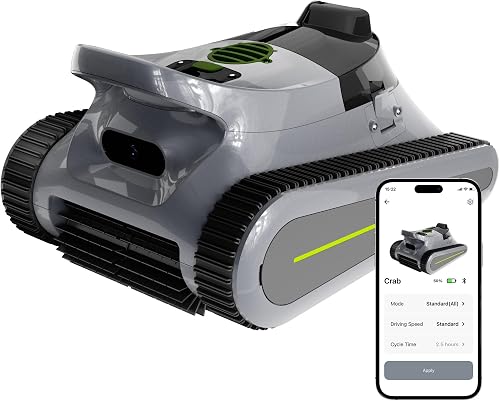
Nepturox Cordless Robotic Pool Cleaner: Best for large pools with full coverage
- 180W brushless motor
- 45000Pa suction
- Wall and waterline climbing
- Auto path mapping
A cordless climber with a strong brushless motor and app control. The 250μm basket grabs larger debris, while its fine silt handling is lighter than the AIPER's.
Pros
- Covers floors, walls and waterline
- High 45000Pa suction rating
- Three cleaning modes and app control
Cons
- 250μm basket misses the finest haze
- App control adds a setup step
Nepturox suits a large pool up to 2150 sq ft where algae has spread across floors, walls and the waterline. The 180W brushless motor and 45000Pa suction rating give it strong pulling power for a cordless robot.
A 7800mAh lithium battery backs that motor.
Its 250μm basket catches leaves, silt and larger debris, but it is coarser than the 3μm filters on the AIPER models. Fine green haze may pass through and need a second pass.
Auto path mapping and app control help it cover the pool without repeated overlaps, and the app also offers floor, wall and all-coverage modes.
A 180-minute runtime suits a big pool in one charge, and the IP68 sealed build is rated for underwater use. Charging takes about 3 hours.
The trade-off against the top picks is filtration: this robot is built to handle volume and mixed debris, not to polish the finest haze out of cloudy water.
Buy it for a large pool that needs full-coverage cleaning. Skip it if your main problem is the finest algae particles, where the AIPER Scuba X1 filters better.
Aiper Scuba S1: Best for scheduled daily cleaning
- 3-micron ultra-fine filter
- 11 high-precision sensors
- Up to 270 minutes in Eco Mode
- Floor, wall, waterline and shallow areas
An app-connected robot with a weekly cleaning plan and a 3-micron filter. Running it daily keeps algae from settling before it turns the water green.
Pros
- Scheduled weekly cleaning plan
- Replaceable 3-micron fine filter
- Cleans shallow areas above 12 in
Cons
- Eco Mode runtime only with app settings
- Higher tier than the budget picks
The Aiper Scuba S1 suits a pool owner who wants the robot to run on a schedule. A weekly custom cleaning plan in the app keeps algae from settling, and 11 high-precision sensors with adaptive navigation reduce missed spots.
The WavePath pattern is designed to cover the pool with minimal overlap.
Its dual-layer filtration pairs a replaceable 3-micron filter with a 180-micron standard filter. That combination handles both fine haze and larger debris.
AIPER says it cleans the floor, walls, waterline and shallow areas above 12 inches, with Caterpillar treads for climbing.
Runtime reaches 270 minutes in Eco Mode, or 180 minutes in the deeper Auto, Floor, Wall and Scheduled modes. AIPER backs it with a 2-year warranty.
The trade-off against the top pick is that its fine-filter cartridges are replaceable parts you'll buy over time.
Buy it for hands-off daily algae control. Skip it if you want the simplest possible maintenance routine with no app or filter swaps.
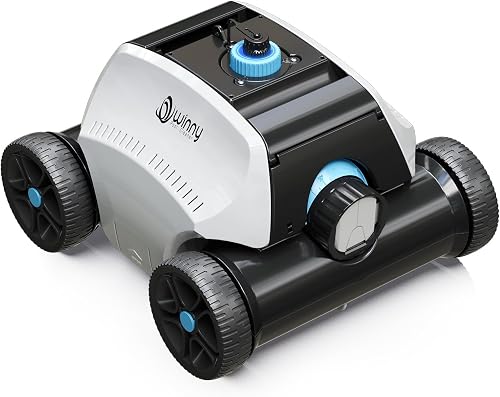
WINNY POOL CLEANER: Best budget above-ground pick
- 55W motor
- 185μm filter basket
- Auto parking at the pool edge
- Up to 1350 sq ft
A light cordless cleaner for flat above-ground pools. The 185μm basket catches sand and debris, and the robot parks itself for easy pickup.
Pros
- Light at 12.13 lb
- Self-parks at the edge when done
- Programmable timer for daily runs
Cons
- Does not climb walls
- 185μm basket is coarser than 3μm filters
The WINNY Pool Cleaner suits a small flat above-ground pool on a budget. Its 55W motor lifts leaves, debris and dirt, and the 185μm basket catches sand and finer particles.
The basket is also sized to hold more debris than standard trays, so you empty it less often during a heavy cleanup.
It handles pools up to 1350 sq ft and runs about 135 minutes from a 6600mAh battery. A programmable timer starts it once a day for up to 7 days, which helps during an algae stretch.
When the cycle ends or the battery runs low, it parks at the pool edge for easy pickup.
It weighs 12.13 lb, so lifting and rinsing are simple. The limits are real: WINNY says it does not climb walls, so wall algae stays put, and it only handles slopes up to 15 degrees.
Its 185μm basket also misses the finest particles that a 3μm filter catches.
Buy it for flat-floor above-ground pools on a tight budget. Skip it if you need wall scrubbing or the finest filtration.
WYBOT B1: Best for quick refresh cycles
- Five cleaning modes
- 1-hour Quick Clean Mode
- Up to 120 minutes runtime
- App control and OTA updates
A light cordless robot with a short quick-clean cycle for pools that need a fast pass. Five modes and app updates make it flexible for small in-ground pools.
Pros
- 1-hour Quick Clean Mode
- Five selectable cleaning modes
- Light 14.3 lb body
Cons
- Shorter 120-minute runtime
- Smaller coverage at 1150 sq ft
WYBOT B1 suits a small in-ground or above-ground pool that needs a fast refresh. Its 1-hour Quick Clean Mode gives the water a quick pass before guests arrive, while the full cycle runs up to 120 minutes.
The battery is a 29.4V lithium-ion pack.
Five cleaning modes and app control let you target the floor or walls. WYBOT says built-in OTA updates improve navigation over time.
Bottom roller brushes and dual front side brushes handle edges and corners, and the body is designed to glide over drains, seams and uneven floors.
It covers pools up to 1150 sq ft, the smallest area in this group. The 120-minute runtime is also shorter than the AIPER and Nepturox models.
For an algae cleanup that needs repeated daily runs, those longer-running units are the better fit.
Buy it for quick refresh passes in a compact pool. Skip it if you have a large pool or a heavy bloom that needs long runs.
2026 Release Robotic Pool Vacuum (Wall Climbing): Best for sloped pool floors
- 4800 GPH suction
- Climbs slopes up to 40°
- 190 minutes runtime
- Floor, wall and waterline modes
A cordless climber that handles steep slopes and uneven surfaces. Its 190-minute runtime suits large pools, but its suction rating sits below the top picks.
Pros
- Climbs slopes up to 40°
- Long 190-minute runtime
- Covers floor, walls and waterline
Cons
- 4800 GPH is lower than the AIPER's 6600 GPH
- Lower overall score for finer filtration
The 2026 Release Robotic Pool Vacuum suits a pool with steep slopes or uneven surfaces. Its tracks climb up to 40°, which is steeper than the flat-floor units here handle.
Sonar 2.0 navigation steers it across tile, vinyl and concrete.
Dual brushless motors run at 3200 RPM with 4800 GPH suction. That is lower than the AIPER's 6600 GPH, so it may need more than one pass on heavy algae.
A 190-minute runtime covers up to 2150 sq ft, and the battery recharges in about 3 hours.
Floor, wall and full-coverage modes give you options for different pool zones. The trade-off is its lower suction rating and overall score against the top picks.
If slope climbing matters more than raw pull, it earns its spot.
Buy it for sloped or uneven pool floors. Skip it if maximum suction on thick algae is the priority.
TALOSBO C1: Best for app-controlled wall scrubbing
- Triple motors
- Dual active roller brushes
- 7 cleaning modes via app
- Up to 180 minutes in Eco Mode
A wall-climbing cordless robot with dual brushes and app control. The 180 minutes applies to Eco Mode only, so full-pool runs finish sooner.
Pros
- Dual roller brushes for wall scrubbing
- Seven cleaning modes via app
- Dual-layer filtration
Cons
- Runtime drops in full pool mode
- Weaker climbing reports for narrow steps
The TALOSBO C1 suits a pool owner who wants app control and wall scrubbing in one unit. Three motors and dual active roller brushes work the floor, walls and waterline.
The ABS body measures 15.9 by 15.7 by 11 inches.
It runs up to 180 minutes in Eco Mode, though TALOSBO says a full pool run drops to about 90 to 100 minutes. Dual-layer filtration captures both large debris and fine particles.
The app offers up to 7 cleaning modes, self-parking and firmware updates over Bluetooth or Wi-Fi.
For algae, the dual brushes are the useful part: they scrub surfaces rather than just vacuum them. The lower runtime in full mode is the main trade-off against the longer-running cordless models.
TALOSBO also notes it won't clean narrow step surfaces well, and it covers up to 1615 sq ft.
Buy it for app-driven wall scrubbing. Skip it if you need long single-charge runtime or good step cleaning.
How these robotic pool cleaners compare
Every pick here removes algae from the water, but they differ in how much of the pool they touch and how fine a particle they catch. Use this table to match a cleaner to your pool's shape and your bloom's severity.
| Product | Best for | Power source | Cleaning coverage | Filter access | Our score |
|---|---|---|---|---|---|
| Dolphin Nautilus CC | overall for algae | Corded Electric | Floor and walls | Top-load basket | 9.7 |
| AIPER Scuba X1 | fine algae particles | Battery Powered | 9.5 | ||
| Dolphin Nautilus AG | flat-floor above-ground pools | AC/DC | Floor only | 8.6 | |
| Nepturox Cordless Robotic Pool Cleaner | large pools with full coverage | Battery Powered | 8.6 | ||
| Aiper Scuba S1 | scheduled daily cleaning | Battery Powered | 8.5 | ||
| WINNY POOL CLEANER | budget above-ground pick | Battery Powered | 8.4 | ||
| WYBOT B1 | quick refresh cycles | Battery Powered | 8.1 | ||
| 2026 Release Robotic Pool Vacuum (Wall Climbing) | sloped pool floors | Battery Powered | 7.6 | ||
| TALOSBO C1 | app-controlled wall scrubbing | Battery Powered | 7.3 |
How we compared these pool cleaners for algae
We ranked these cleaners by four algae-focused checks. First, whether the robot climbs walls and scrubs the waterline, since algae clings to surfaces before it clouds the water.
Wall climbers like the Nautilus CC, Scuba X1, Nepturox and TALOSBO C1 score higher here than floor-only units.
Second, filtration. We compared the basket mesh size on each model, favoring finer ratings for green haze.
The 3μm filters on the AIPER models sit above the 185μm and 250μm baskets on the WINNY and Nepturox units.
Third, coverage area and runtime, so a cleaner can finish a pool in one cycle or a scheduled set of runs. That range runs from 1150 sq ft on the WYBOT B1 to 2150 sq ft on the Nepturox and the 2026 Release model.
Fourth, power source and maintenance. Corded units run without a charge wait; cordless units need a dock and a spare hour between cycles.
Our score weighs specs, features and buyer feedback against what you're shopping for.
Do robotic pool cleaners pick up algae?
Yes. A robotic cleaner vacuums algae and the debris it grows on, but the filter mesh size decides how much it captures.
A 3μm filter like the AIPER Scuba X1's pulls in the fine green haze that a 185μm basket passes through. That is why a cloudy pool often needs a finer filter or more frequent runs than a pool with leaves.
What a robot cannot do is kill the bloom. Algae keeps growing until the water chemistry is balanced.
The cleaner's job is to remove what dies so it does not settle back onto the floor and walls.
If you want the full explanation of what these machines can and cannot capture, our guide on whether robotic pool cleaners pick up algae covers it in more depth.
What filter rating do you need for an algae bloom?
A finer filter catches more algae, and a 3-micron rating is the safest choice for green or cloudy water. It traps particles small enough to look like haze in the water.
3-micron filters
The AIPER Scuba X1, Aiper Scuba S1 and several fine-filter models catch particles down to 3μm. These suit a pool that turns cloudy rather than thick green.
They clog faster, so plan to rinse the filter after each run during a bloom. On the Scuba S1 the fine cartridge is replaceable, which adds a small ongoing cost.
185 to 250-micron filters
The WINNY Pool Cleaner's 185μm basket and the Nepturox 250μm basket handle leaves, sand and larger debris. They are the better choice for a pool with heavy leaf litter, but they let the finest algae through.
A pool with a persistent haze needs a finer filter or more frequent runs. If you choose a coarse basket, empty it after every cycle so the mesh stays open.
How to vacuum a pool with a robotic cleaner after algae
Run the robot daily until the water clears, and empty its basket after every cycle. That order matters more than any single feature when you are fighting a bloom.
Start by fixing the water chemistry, then let the robot make repeated passes. Emptying the basket between runs keeps suction strong.
Our walkthrough on how to vacuum a pool with a robotic cleaner covers placement, cycle length and basket care step by step.
If your pool is small, the robotic pool cleaners under 500 dollars roundup shows what a lower budget buys. For a large pool, our guide to inground robotic pool cleaners narrows the field.
Corded or cordless for algae cleanup?
Corded wins for long or repeated algae runs, because there is no battery to recharge between passes. The Dolphin Nautilus CC runs from a cord and can go again as soon as you empty the basket.
Cordless wins for convenience and storage. The AIPER Scuba X1, Aiper Scuba S1 and Nepturox all charge on a dock and run 180 minutes or more.
That is enough for most pools in one cycle. The WYBOT B1 and the 2026 Release model round out the cordless group with 120 and 190 minutes respectively.
The trade-off is the wait. A cordless unit needs a charge between long runs, while a corded model just needs an outlet and a clear cord path.
For a pool in the middle of a bloom, the corded Nautilus CC removes the charging gap. For a pool you want cleaned while you are at work, a scheduled cordless model earns its keep.
Which cleaning features matter most when algae is the problem?
Wall climbing, a fine filter and a scrubbing brush do the most work on algae. Everything else is convenience.
Wall climbing and waterline scrubbing
Algae clings to walls and the waterline before it settles on the floor. A climber like the Nautilus CC or TALOSBO C1 reaches those surfaces.
A floor-only model like the Nautilus AG leaves them green. If your pool has a visible ring of algae at the tile line, wall climbing is the first feature to check.
Scrubbing brushes
An active brush lifts algae films off surfaces so the filter can catch them. Dual roller brushes, as on the AIPER Scuba X1 and TALOSBO C1, cover more surface per pass than a single brush.
A brush matters most on textured surfaces like vinyl and plaster, where films grip harder.
Fine filtration
The mesh size decides what the basket keeps. Fine 3μm filters handle haze; coarse baskets handle leaves.
Match the rating to your water condition. A pool with both leaves and haze needs either a fine filter or more frequent runs with a coarse one.
Runtime and scheduling
Longer runs finish a large pool in one charge. A weekly cleaning plan, as on the Aiper Scuba S1, keeps algae from settling in the first place.
For a pool up to 1350 sq ft, the WINNY's 135-minute cycle and 7-day timer cover a similar idea at a lower price.
Best robotic pool cleaner for algae: the verdict
The Dolphin Nautilus CC is the best robotic pool cleaner for algae for most pool owners. It climbs walls, scrubs surfaces and filters through a top-load basket, all without a charging wait.
Pick the AIPER Scuba X1 if fine green haze is your main problem. Choose the Aiper Scuba S1 for scheduled daily runs, the Dolphin Nautilus AG for a flat above-ground floor, or the WINNY Pool Cleaner for a small pool on a budget.
For a large pool with steep sides, the Nepturox and the 2026 Release model cover more area per charge.
Whichever you choose, fix the water chemistry first and run the robot daily until the water clears. The cleaner removes the algae; the chemistry stops it coming back.
Our top 3 picks at a glance
-
1
-
2
-
3
Frequently asked questions
Will a robotic pool cleaner get rid of green algae?
It removes algae and the debris it grows on, but it cannot kill a bloom on its own. Balance the water chemistry first, then run the robot so the filter captures the dead algae before it settles again.
Can a robotic cleaner run while you shock the pool?
Keep the robot out of the water during a heavy shock and for the waiting period the shock instructions give. High chlorine levels can wear brushes and plastic parts faster, so run the cleaner after the water clears.
How often should you run a robot in an algae-prone pool?
Run it daily while the water is green or cloudy, then drop to two or three times a week once it clears. A scheduled daily plan on models like the Aiper Scuba S1 removes the guesswork.
Does a robot cleaner brush the walls where algae clings?
Only models with wall climbing scrub brushes do. The Dolphin Nautilus CC and TALOSBO C1 climb walls and scrub the waterline; floor-only models like the Dolphin Nautilus AG leave wall algae alone.
Is a finer filter better for algae?
Yes. A 3-micron filter like the AIPER Scuba X1's catches the fine haze that a 185-micron basket passes through.
Fine filters need more frequent rinsing when algae loads are heavy.
Can a cordless robot clean a large algae bloom in one charge?
It depends on the model and the mode. Cordless units run 120 to 190 minutes per charge, so very large pools may need more than one cycle.
Empty the basket between runs so suction stays strong.