9 Best Inground Robotic Pool Cleaners (November 2026)
The best robotic pool cleaners for inground pools include the (2026 New) AIPER Cordless Robotic Pool Cleaner for most inground pools, the WYBOT B1 Cordless Robotic Pool Vacuum Pool for small inground pools, and the Dolphin Robotic Pool Vacuum for In-Ground Pools (best corded plug-and-play cleaner).
On this page (5 sections)
The best inground robotic pool cleaner for most pools is the AIPER Scuba X1, which combines 6600 GPH dual-jet suction, a 3μm MicroMesh filter and cleaning that reaches 2 inches above the waterline. Pick the WYBOT B1 if your pool is small and you want a light robot with app control.
The Dolphin Nautilus CC Plus is the better fit when you would rather plug in and skip the charging dock.
Inground pools come in very different shapes, and so do the jobs their owners need done. A big pool with deep walls needs long runtime and strong climbing.
A small pool with a light debris load is better served by a compact robot you can lift out with one hand. A pool with sand and algae needs fine filtration more than raw power.
That is why this list ranks by score but splits the picks by the need each one handles best.
Our picks at a glance
-
1
 Best for most inground pools
(2026 New) AIPER Cordless Robotic Pool Cleaner
9.5/10 our score
See it on Amazon -
2
 Best for small inground pools
WYBOT B1 Cordless Robotic Pool Vacuum Pool
9.0/10 our score
See it on Amazon -
3
 Best corded plug-and-play cleaner
Dolphin Robotic Pool Vacuum for In-Ground Pools
8.9/10 our score
See it on Amazon
- 4
 Check it
WITBOX 2026 Upgrade Robotic Pool Cleaner
Best for long runtime on big pools - 5
 Best for app scheduling and four-zone cleaningCheck it
- 6
 Best budget corded wall climberCheck it
- 7
 Check it
CZYBYTE Cordless Robotic Pool Vacuum Cleaner
Best for large debris loads - 8
 Check it
2026 Release Robotic Pool Vacuum (Wall Climbing)
Best for sloped and uneven floors - 9
 Best for app-controlled wall climbingCheck it
The best inground robotic pool cleaners, ranked
Every pick here cleans an inground pool floor, but they split by how much runtime you get, how fine the filter is and whether the robot climbs walls. The top score goes to the broadest fit, and each product below earns its place on one clear strength.
Reading down the list in score order, the first two are cordless and the third runs from a cable, so the split between battery freedom and no-charge reliability shows up early. The last four fill narrower gaps: debris volume, sloped floors and fine app control.
If your pool matches none of those special cases, the top pick covers the widest range of inground layouts.
(2026 New) AIPER Cordless Robotic Pool Cleaner: Best for most inground pools
- 6600 GPH dual-jet suction
- 3μm MicroMesh Ultra filter
- Waterline cleaning 2 in above the surface
- Wireless charging dock
Strong dual-jet suction, a very fine filter and waterline scrubbing make this the broadest fit for a typical inground pool.
Pros
- 6600 GPH suction with dual jets
- 3μm MicroMesh fine filter
- Reaches 2 in above the waterline
- 2-year warranty
Cons
- Premium price tier
- A full charge takes 3.5 hours
The AIPER Scuba X1 is the pick for a typical inground pool because it covers the most ground in one cycle without giving up filtration. Its dual-jet suction pulls 6600 GPH, which is the highest figure in this group, and the multi-layer filter traps debris down to 3μm.
Fine sand and algae are exactly the particles that cloud water and clog coarser baskets, so the fine mesh matters more than the headline number. The 18 x 11 x 20 in body is compact enough to carry, and OTA updates keep the cleaning paths improving after you buy.
The WaveLine 2.0 system takes the robot 2 inches above the waterline and holds 60 seconds of horizontal cleaning there. That handles the scum line that floor-only robots leave behind.
Dual front PVC brushes scrub wall stains as it climbs. AIPER lists up to 180 minutes of runtime and a 2-year warranty, and the wireless charging dock means you set it down rather than hunting for a cable.
A full charge takes 3.5 hours. This is the premium end of the list, and the price reflects the extra reach.
For a pool with walls and a visible waterline, it is the easiest one to recommend.
WYBOT B1 Cordless Robotic Pool Vacuum Pool: Best for small inground pools
- 14.3 lb body
- 5 cleaning modes via app
- Up to 120 min runtime
- 1-hour Quick Clean mode
Light enough to lift out with one hand and small enough to store easily, with app control and a fast refresh cycle.
Pros
- Lightweight 14.3 lb build
- 5 cleaning modes in the app
- Quick Clean mode in 1 hour
- Handles drains and slopes
Cons
- 120 min runtime is shorter than the top pick
- Best suited to pools up to about 1,150 sq ft
The WYBOT B1 suits a smaller inground pool where lifting a heavy robot out of the water is the part you dread. It weighs 14.3 lb and has a compact body, so one person can pull it up and store it without strain.
The dual front side brushes reach edges and corners that a plain floor scrubber misses. The body measures about 13.8 x 13.7 x 9.3 in, so it stores on a shelf or in a corner without a dedicated spot.
Five cleaning modes in the WYBOT app let you send it to the floor, the walls or a combination, and the 1-hour Quick Clean mode is useful before guests arrive. Runtime runs up to 120 minutes, enough for pools up to about 1,150 sq ft.
Roller brushes keep it moving over drains, seams and slopes without stalling. The 6-liter basket holds a normal debris load.
The trade-off is cycle length: on a large pool you would need more than one run, so it fits a compact pool better than a sprawling one. Buyers who want a light, app-driven robot for a modest pool get the best fit here.
Dolphin Robotic Pool Vacuum for In-Ground Pools: Best corded plug-and-play cleaner
- Wall climbing with active scrubbing brush
- Top-load filter basket
- 2-hour cleaning cycle
- Works in pools up to 40 ft long
No battery to charge and no dock to store: plug it in, drop it in and let it climb and scrub the walls.
Pros
- No charging downtime
- Climbs walls and scrubs surfaces
- Easy top-load filter basket
- 40 years of Dolphin cleaner history
Cons
- Cord adds a step to setup and storage
- Needs a power outlet near the pool
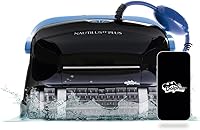
The Dolphin Nautilus CC Plus is the corded option, and that changes the routine more than the spec sheet suggests. You plug it in, drop it in the water and switch it on, and there is no battery to charge and no dock to store.
Dolphin rates it for inground pools up to 40 ft in length, the longest reach of the corded models here. The active scrubbing brush works the walls as it climbs, and the top-load filter basket pulls out from above so you never reach into the water to clear it.
At 22.2 x 17.6 x 12.9 in it takes more storage room than the cordless picks.
A cycle takes about 2 hours. Because the robot runs from an outlet rather than a battery, it can keep going as long as you leave it connected.
The trade-off is the cord: it needs an outlet near the pool and you manage the cable during setup and storage. Dolphin has been building pool cleaners for over 40 years, and this model carries a limited warranty.
Pick it if reliability and zero charging downtime beat the freedom of a cordless robot.
WITBOX 2026 Upgrade Robotic Pool Cleaner: Best for long runtime on big pools
- Up to 210 min runtime
- Covers up to 2,200 sq ft
- 2.7L debris basket with 180μm filter
- Smart auto-parking
The longest stated runtime in this group, aimed at larger pool floors where shorter cycles leave gaps.
Pros
- 210 min runtime
- 2,200 sq ft coverage
- Smart parking near the edge
- Quick-drain system cuts lifting weight
Cons
- Filter mesh is coarser than the top pick's
- Floor-focused design rather than full wall climbing
The WITBOX robotic cleaner is for the owner of a large pool floor who is tired of short cycles that stop before the robot finishes. It runs up to 210 minutes on a charge and covers up to 2,200 sq ft, which is the biggest stated coverage in this group.
Smart path planning adapts to round, rectangular and oval pool shapes. Dual water inlets and extended brushes cover more surface in a single pass.
The 2.7L debris basket is larger than most here and carries a 180μm fine filter, so it catches sand and dust without needing a mid-cycle empty. Smart auto-parking brings it to the pool edge when the battery drops or the job ends, and the quick-drain system reduces the weight you lift out.
A floating handle and a standard hook let you retrieve it one-handed. It works on tile, fiberglass, concrete and vinyl, and WITBOX states a water temperature range of 50°F to 113°F.
The trade-off against the top AIPER pick is filtration depth: 180μm is coarser than a 3μm mesh, so fine algae particles pass through. For a big floor with leaves and grit, the long cycle is the stronger advantage.
A full charge takes 4.5 hours.
Aiper Scuba S1: Best for app scheduling and four-zone cleaning
- Floor, wall, waterline and shallow-area cleaning
- Dual filtration with 3μm and 180μm filters
- 11 high-precision sensors
- Eco Mode up to 270 min
Aiper's four-zone cleaning and weekly custom schedule suit owners who want set-and-forget maintenance.
Pros
- Cleans four zones including shallow areas
- Replaceable 3μm fine filter
- Weekly custom cleaning plan in the app
- 2-year warranty
Cons
- Lower stated suction than the top pick
- Full schedule depends on app use
The Aiper Scuba S1 earns its place through scheduling and zone coverage rather than raw suction. It cleans the floor, walls, waterline and shallow areas above 12 inches, so steps and the top of the pool get attention that floor-focused robots skip.
Eleven high-precision sensors and the WavePath cleaning pattern keep it on a systematic route with less overlap. The Caterpillar Treads system is what holds it to the walls and helps it climb.
Dual filtration pairs a replaceable 3μm ultra-fine filter with a 180μm standard filter, so you can swap to the fine mesh when algae is the problem. Runtime reaches up to 180 minutes in Auto, Floor, Wall or Scheduled modes, and Eco Mode stretches that to 270 minutes for daily upkeep.
The weekly custom cleaning plan in the app makes hands-free maintenance realistic. Aiper backs it with a 2-year warranty and cites more than 500,000 pool owners using its cleaners.
The trade-off against the top pick is suction strength and the reliance on the app for the schedule. Pick it if you want a robot that plans your week for you.
Dolphin Proteus DX3: Best budget corded wall climber
- Wall climbing
- Active scrubbing brush
- Top-load filter basket
- Works in pools up to 33 ft long
A lower-cost corded Dolphin for smaller inground pools that still need wall scrubbing.
Pros
- Corded design means no charging wait
- Climbs walls with an active scrubber
- Top-load filter is easy to clear
- Lower price tier than the Nautilus
Cons
- Shorter length rating than the Nautilus
- Cord management during storage
The Dolphin Proteus DX3 is the lower-cost way to get a corded wall climber. It shares the Nautilus formula at a smaller scale: it climbs walls, scrubs with an active brush and clears through a top-load filter basket.
There is no battery and no charging wait, and a cycle takes about 2 hours. It's rated for inground pools up to 33 ft in length, so it fits a modest pool better than a long one.
If you're cleaning a smaller fiberglass pool, see our guide to the best robotic pool cleaner for fiberglass pool surfaces.
The 14.8 lb body and 22.2 x 17.6 x 12.8 in footprint are close to the Nautilus, so the lifting and storage routine is the same. The difference is reach and price tier.
The trade-off against the Nautilus is the shorter pool rating, not the cleaning action. Pick it when wall scrubbing matters and you want the simpler corded setup at a lower price tier.
CZYBYTE Cordless Robotic Pool Vacuum Cleaner: Best for large debris loads
- 4500 GPH brushless-motor suction
- 4L debris basket with 150μm mesh
- Wall and waterline cleaning
- Smart auto-parking
The 4L basket catches leaves and hair in bulk, so you empty it less often on a debris-heavy pool.
Pros
- Large 4L debris basket
- Cleans floor, walls and waterline
- Parks above the water when done
- S-shaped path planning
Cons
- Shorter runtime than the long-runtime picks
- Suction below the top pick's
The CZYBYTE robot is built around debris volume. Its 4L top-load basket with 150μm mesh holds a full load of leaves and hair, so on a pool that collects them you empty it less often.
Brushless motors drive suction up to 4500 GPH, and S-shaped navigation plans a full route across the floor. It cleans the floor, walls and waterline, then parks above the surface when the battery runs low or the job ends.
A three-mode cycle starts on the walls and waterline before moving to a full floor scrub.
Runtime reaches about 120 minutes for pools up to 2,000 sq ft. The basket catches everything from fine particles up to leaves.
The trade-off against the higher-scoring picks is twofold: shorter cycle time and lower suction. The large basket offsets some of that on a debris-heavy pool, because a full basket strangles suction on any robot.
CZYBYTE notes that you should cover the charging port before the machine goes in the water. Pick it if your pool fills with leaves faster than it fills with fine silt.
2026 Release Robotic Pool Vacuum (Wall Climbing): Best for sloped and uneven floors
- 4800 GPH suction with dual brushless motors
- Climbs slopes up to 40°
- 190 min runtime
- Covers up to 2,150 sq ft
Tracks and 40° slope climbing make this a fit for pools with ramps, steps and uneven depth.
Pros
- Climbs slopes up to 40°
- 190 min runtime
- 2,150 sq ft coverage
- Floor, wall and waterline modes
Cons
- Standard filtration only
- Lower score than the Dolphin corded pair
This Lodoba-built robot targets pools with slopes and uneven floors. Tracks let it climb up to 40°, and 2.0 sonar navigation guides it across tile, vinyl and concrete.
Dual brushless motors turn at 3200 RPM and pull 4800 GPH, enough for leaves, sand and scum. You choose floor, wall or full coverage from the controls.
The touch control keeps the choice simple rather than burying modes in an app.
Runtime runs up to 190 minutes and covers up to 2,150 sq ft, with a charge time of about 2.5 hours. The body is 15.12 x 9.86 x 16.72 in.
The trade-off is filtration: it uses a standard basket rather than the fine mesh on the top picks, so very fine particles are less of a focus. The slope climbing is the reason to choose it.
A pool with a ramp, a shallow end that drops away or sloped steps gives a flat-floor robot trouble, and tracks handle that terrain better. Pick it when your pool's shape is the hard part, not its debris load.
TALOSBO C1: Best for app-controlled wall climbing
- Triple-motor power with dual roller brushes
- 7 cleaning modes in the app
- 180 min runtime in Eco Mode
- Dual-layer filtration
Seven app modes give fine control over where the robot cleans, and dual roller brushes tackle the waterline.
Pros
- 7 cleaning modes
- Triple motors and dual roller brushes
- Climbs walls and scrubs the waterline
- 2.5-hour charge time
Cons
- Eco Mode only for the 180 min figure
- Step surfaces are not its strong point
The TALOSBO C1 puts the most control in your hands. Seven cleaning modes in the app let you send the robot to specific areas or run a full cycle, and triple motors with dual roller brushes work the floor, walls and waterline.
Dual-layer filtration catches large debris and fine particles in one basket. It runs up to 180 minutes in Eco Mode and charges in 2.5 hours.
The ABS body measures about 15.9 x 15.7 x 11 in.
The trade-off comes in two places. The 180-minute figure applies to Eco Mode only; full pool mode runs closer to 90 to 100 minutes.
And TALOSBO notes that the robot can climb steps but won't clean narrow step surfaces well. If the basket fills or it catches on a drain, it backs itself out within 2 to 3 minutes.
It's rated for inground pools up to 1,615 sq ft. Pick it if you like fine control over where the robot cleans and your pool is on the smaller side.
For a bigger pool, the longer-runtime picks above are the better match.
How these inground pool robots compare
The comparison table lines up the specs that decide most purchases: power source, stated runtime and filtration type. Corded models never need a charge; cordless models trade charging time for freedom from the cable.
Runtime and filter mesh are the two numbers that most affect how clean a pool stays between runs. Coverage area tells you whether one cycle finishes the job or leaves a section for next time.
Basket size and charging time are the everyday details that decide how much work the robot adds to your week.
| Product | Best for | Power source | Runtime | Filtration | Our score |
|---|---|---|---|---|---|
| (2026 New) AIPER Cordless Robotic Pool Cleaner | most inground pools | Battery (lithium-ion) | Up to 180 min | Multi-layer, 3μm fine | 9.5 |
| WYBOT B1 Cordless Robotic Pool Vacuum Pool | small inground pools | Battery (lithium-ion) | Up to 120 min | 9.0 | |
| Dolphin Robotic Pool Vacuum for In-Ground Pools | corded plug-and-play cleaner | AC/DC corded | Top-load basket | 8.9 | |
| WITBOX 2026 Upgrade Robotic Pool Cleaner | long runtime on big pools | Battery (lithium-ion) | Up to 210 min | 8.7 | |
| Aiper Scuba S1 | app scheduling and four-zone cleaning | Battery (lithium-ion) | Up to 180 min (270 min Eco) | Dual layer, 3μm + 180μm | 8.5 |
| Dolphin Proteus DX3 | budget corded wall climber | AC/DC corded | Top-load basket | 8.5 | |
| CZYBYTE Cordless Robotic Pool Vacuum Cleaner | large debris loads | Battery (lithium-ion) | Up to 120 min | 8.0 | |
| 2026 Release Robotic Pool Vacuum (Wall Climbing) | sloped and uneven floors | Battery (lithium-ion) | Up to 190 min | Standard basket | 7.6 |
| TALOSBO C1 | app-controlled wall climbing | Battery (lithium-ion) | Up to 180 min (Eco) | 7.3 |
How we compared these robotic pool cleaners
We ranked these robots by matching their stated specs to what inground pool owners actually need, then weighing how each one fits a different pool. Our score weighs specs, features and buyer feedback against what you're shopping for.
Every figure comes from the manufacturer's product data.
We started with suction and filtration, because those decide whether a robot lifts fine sand and algae or just the leaves. The spread runs from 4500 GPH on the CZYBYTE to 6600 GPH on the AIPER Scuba X1, and filter mesh runs from a standard basket down to 3μm.
Runtime and coverage came next: a robot rated below your pool's surface area needs more than one cycle. The WITBOX covers 2,200 sq ft on a 210-minute charge, while the TALOSBO covers 1,615 sq ft on 180 minutes in Eco Mode.
Then we looked at cleaning reach, separating floor-only designs from models that climb walls and scrub the waterline. Power source split the field into cordless robots with docks and corded robots with a cable.
Charging time ranged from 2.5 hours on the TALOSBO to 4.5 hours on the WITBOX. Finally, we checked storage and maintenance details such as basket size, parking behavior and how the robot is retrieved from the water.
The ranking reflects fit for a typical inground pool rather than a single test.
Which inground robotic pool cleaner fits your pool?
The right robot depends on your pool's size, its walls and how much debris lands in it. Use these questions to narrow the field before you buy.
Each answer points to the model whose stated specs match that job, so you can skip the ones built for a different pool.
How big is your pool?
Measure the surface area and compare it with the stated coverage. A pool up to about 1,150 sq ft is served well by the WYBOT B1.
Pools closer to 2,000 sq ft or more need the longer cycles of the WITBOX or the AIPER Scuba X1. The CZYBYTE covers up to 2,000 sq ft on 120 minutes.
A robot rated below your pool size will need extra runs to finish the job.
Does your pool have walls and a waterline to scrub?
If the answer is yes, choose a climbing model. The AIPER Scuba X1 reaches 2 inches above the waterline and holds there for 60 seconds.
The Dolphin Nautilus climbs walls with an active brush. Floor-only robots leave the scum line alone.
If your pool is mostly a flat floor with little wall staining, a floor-focused design like the WITBOX saves money without a real loss.
How much debris lands in your pool?
A pool under trees collects leaves and needs basket volume. The CZYBYTE 4L basket is the largest here.
A pool with fine sand or algae needs filter mesh: the AIPER Scuba X1 and Aiper Scuba S1 both go down to 3μm. Match the filter to the debris type, not just the basket size.
A coarse basket on a sandy pool means the fine grit recirculates.
Corded or cordless?
Cordless robots are easier to drop in and store, and there is no cable to manage. Corded robots like the Dolphin pair run from an outlet with no charging downtime.
Choose cordless for convenience and corded for longer sessions without a battery limit. Either way, keep a power outlet or a charging dock near the pool.
What about slopes and uneven floors?
Tracks and slope climbing matter on pools with ramps or a shallow end that drops away. The Lodoba robot climbs up to 40°, the steepest rating here.
A flat-floor robot can stall on a steep transition. If your pool has a smooth, level floor, this feature adds little.
If it has steps, note that the TALOSBO can climb them but won't clean narrow step surfaces well.
How much setup and storage space do you have?
The WYBOT B1 weighs 14.3 lb and is one of the lightest cordless picks, while the corded Dolphin models need a cable and an outlet. The AIPER Scuba X1 comes with a wireless charging dock that doubles as storage.
The WITBOX adds a quick-drain system and a floating handle to cut the lifting weight. Check where the robot will sit between runs and how much lifting you are willing to do.
A light robot with a dock is easier to live with day to day than a heavy one you have to haul out and drape with a cable.
Verdict: the best inground robotic pool cleaner for most pools
The AIPER Scuba X1 is the best inground robotic pool cleaner for most owners, with the strongest suction here, a 3μm fine filter and waterline cleaning in one machine. Pick the WYBOT B1 if your pool is small and you want a light robot with app control.
The Dolphin Nautilus CC Plus is the choice when you prefer a corded cleaner with no charging routine. For a large floor with leaves and grit, the WITBOX's 210-minute runtime covers more ground.
If your pool has steep slopes or steps, the Lodoba tracks handle that terrain better than the flat-floor models. Once you have your pick, our guide on how to vacuum pool with robotic cleaner walks through a full run, and our roundup of robotic pool cleaners under 500 covers budget options.
If you're still weighing the cost, read whether robotic pool cleaners are worth it.
Our top 3 picks at a glance
-
1
Best for most inground pools
(2026 New) AIPER Cordless Robotic Pool Cleaner
9.5/10 our score
See it on Amazon -
2
Best for small inground pools
WYBOT B1 Cordless Robotic Pool Vacuum Pool
9.0/10 our score
See it on Amazon -
3
Best corded plug-and-play cleaner
Dolphin Robotic Pool Vacuum for In-Ground Pools
8.9/10 our score
See it on Amazon
Frequently asked questions
Are cordless robotic pool cleaners better than corded ones?
Cordless robots skip the cord and the outlet, so setup is quicker and there is nothing to tangle. Corded models like the Dolphin Nautilus run without a battery and never need charging.
Pick cordless for convenience and corded for a simpler long session.
How much suction do I need in an inground pool robot?
Around 4,500 GPH handles leaves, sand and normal debris. The strongest models here reach 6,600 GPH, which helps on pools with fine sand or algae.
Match suction to your debris load rather than buying the biggest number.
Do robotic pool cleaners climb walls?
Many do, and the models here that climb also scrub the waterline. AIPER, Dolphin, Aiper and TALOSBO all state wall and waterline cleaning.
A floor-only design can still be enough for a pool with mostly floor debris.
How long does a cordless pool robot run on a charge?
Runtime ranges from about 120 minutes to 270 minutes in eco mode. The AIPER Scuba X1 runs up to 180 minutes, the WITBOX up to 210 minutes and the Aiper Scuba S1 up to 270 minutes in Eco Mode.
Larger pools need the longer cycles.
What size pool can one robotic cleaner handle?
Small robots cover pools up to about 1,150 sq ft, while the long-runtime models cover up to 2,200 sq ft. Check your pool's surface area against the stated coverage before you choose.
A cleaner rated below your pool size will need more than one cycle.
How often should I run a robotic pool cleaner?
Two or three times a week keeps most inground pools clear, and daily runs help during heavy leaf fall or after storms. A scheduled mode makes this easier on app-connected models.
Empty the filter basket after each run to keep suction strong.